
Researchers have developed a new compound, MPI 8, that offers a safer and more effective blood thinner by targeting a non-essential molecule in blood clotting. The drug has shown promise in animal models without increased bleeding risk, and its design platform may allow for additional similar compounds.
Safer and more effective blood thinners could be on the way following a groundbreaking discovery by researchers at the University of British Columbia (UBC) and the University of Michigan, published today (April 26, 2023) in Nature Communications.
By combining their expertise in blood clotting systems and chemical synthesis, the researchers have designed a new compound called MPI 8 that offers the potential to prevent blood clots without any increased risk of bleeding—a common side effect of existing blood thinners.
“The development of MPI 8 represents a major breakthrough in the field of blood clot prevention and treatment,” said Dr. Jay Kizhakkedathu, a professor and Canada Research Chair at UBC’s department of pathology and laboratory medicine and the UBC Centre for Blood Research. “By targeting a specific molecule involved in clot formation without disrupting the natural clotting process, we’ve created a blood thinner that has proven safer and more effective in animal models, with enormous potential to improve human lives as well.”
Further research will be needed to confirm the safety and efficacy of MPI 8 in humans, but initial results offer hope for a new era in blood clot prevention and thrombosis treatment while serving as a testament to the power of collaboration in research medicine.
Addressing the Risks of Current Anticoagulants
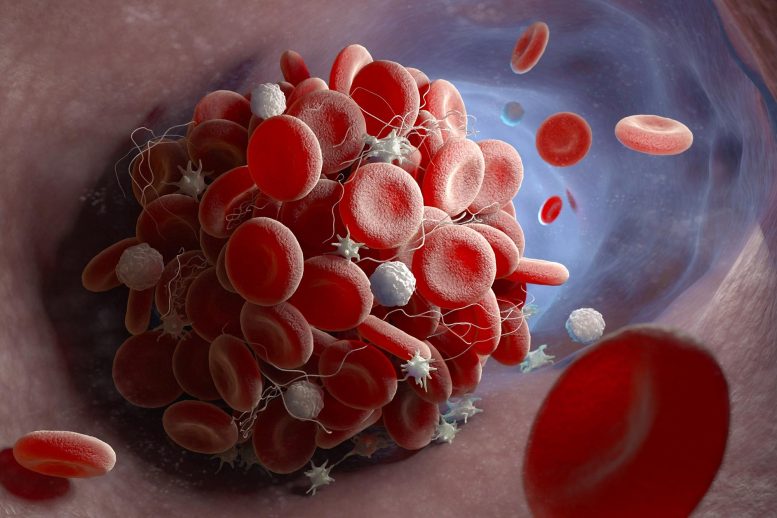
Blood clots are a serious health concern affecting millions of people around the world. When left untreated, they can lead to life-threatening conditions such as deep vein thrombosis, heart attack, pulmonary embolism, and stroke.
Blood thinners, also known as anticoagulants or antithrombotic drugs, are essential in the treatment and prevention of blood clots but carry a significant risk of bleeding. This can cause complications and limit their use in some patients.
Existing blood thinners such as heparin, direct oral anticoagulants (DOACs) and warfarin work by targeting enzymes that are essential for blood clotting. However, they must be carefully dosed and monitored because disabling those enzymes threatens the normal clotting process required to heal wounds.
UBC and Michigan researchers took an innovative approach to instead target polyphosphate, a molecule involved in blood clotting that accelerates the process but is not essential for it.
Designing MPI 8: The Role of Innovative Chemistry
“Our thought was that polyphosphate might be a safer target to go after with an antithrombotic drug, because it would just slow these clotting reactions down—even if we take out 100 per cent of the action of the polyphosphate,” said Dr. Jim Morrissey, a professor of biological chemistry and internal medicine at the University of Michigan whose work has illuminated the role of polyphosphate in blood clotting. “We really had to come up with an extremely novel way to target it compared to the usual drugs that target clotting, and that’s where the expertise of Dr. Kizhakkedathu’s lab became so important.”
After building a library of potential molecules and screening them for their desired criteria, the Kizhakkedathu lab zeroed in on MPI 8. This unique molecule has “smart” binding groups with positive charges that are drawn to polyphosphate’s negative charge. It will bind to polyphosphate and inhibit it while leaving the body’s other negatively charged cells and proteins alone, eliminating toxic side effects.
In preclinical studies, MPI 8 demonstrated remarkable effectiveness in preventing blood clots in mice without increasing bleeding risk. The drug showed no signs of toxicity, even at high doses.
“Not only does the drug show promise as a safer and more effective option for patients, but the design platform we used to create MPI 8 is flexible, potentially allowing for the development of additional compounds with similar properties and efficacy,” said Dr. Chanel La, who worked on the project as a chemistry PhD student in the Kizhakkedathu lab. “Assuming our work continues to produce positive results, I would be very excited to get MPI 8 into an approved clinical trial and bring this drug closer to becoming a reality for patients in need.”
Reference: “Smart thrombosis inhibitors without bleeding side effects via charge tunable ligand design” by Chanel C. La, Stephanie A. Smith, Sreeparna Vappala, Reheman Adili, Catherine E. Luke, Srinivas Abbina, Haiming D. Luo, Irina Chafeeva, Matthew Drayton, Louise A. Creagh, Maria de Guadalupe Jaraquemada-Peláez, Nicole Rhoads, Manu Thomas Kalathottukaren, Peter K. Henke, Suzana K. Straus, Caigan Du, Edward M. Conway, Michael Holinstat, Charles A. Haynes, James H. Morrissey and Jayachandran N. Kizhakkedathu, 26 April 2023, Nature Communications.
DOI: 10.1038/s41467-023-37709-0
UBC and the University of Michigan have filed a patent application for the technology.
Funding: Canadian Institutes of Health Research, Natural Sciences and Engineering Council of Canada, National Institutes of Health
Never miss a breakthrough: Join the SciTechDaily newsletter.
Follow us on Google and Google News.